What really causes melasma, and why it keeps coming back
You treated it. It faded. Then one summer, or one new product, and it was back, sometimes darker than before. If that is your story, you have probably been told melasma is a pigment problem and the answer is to fade the pigment.
Quick answer
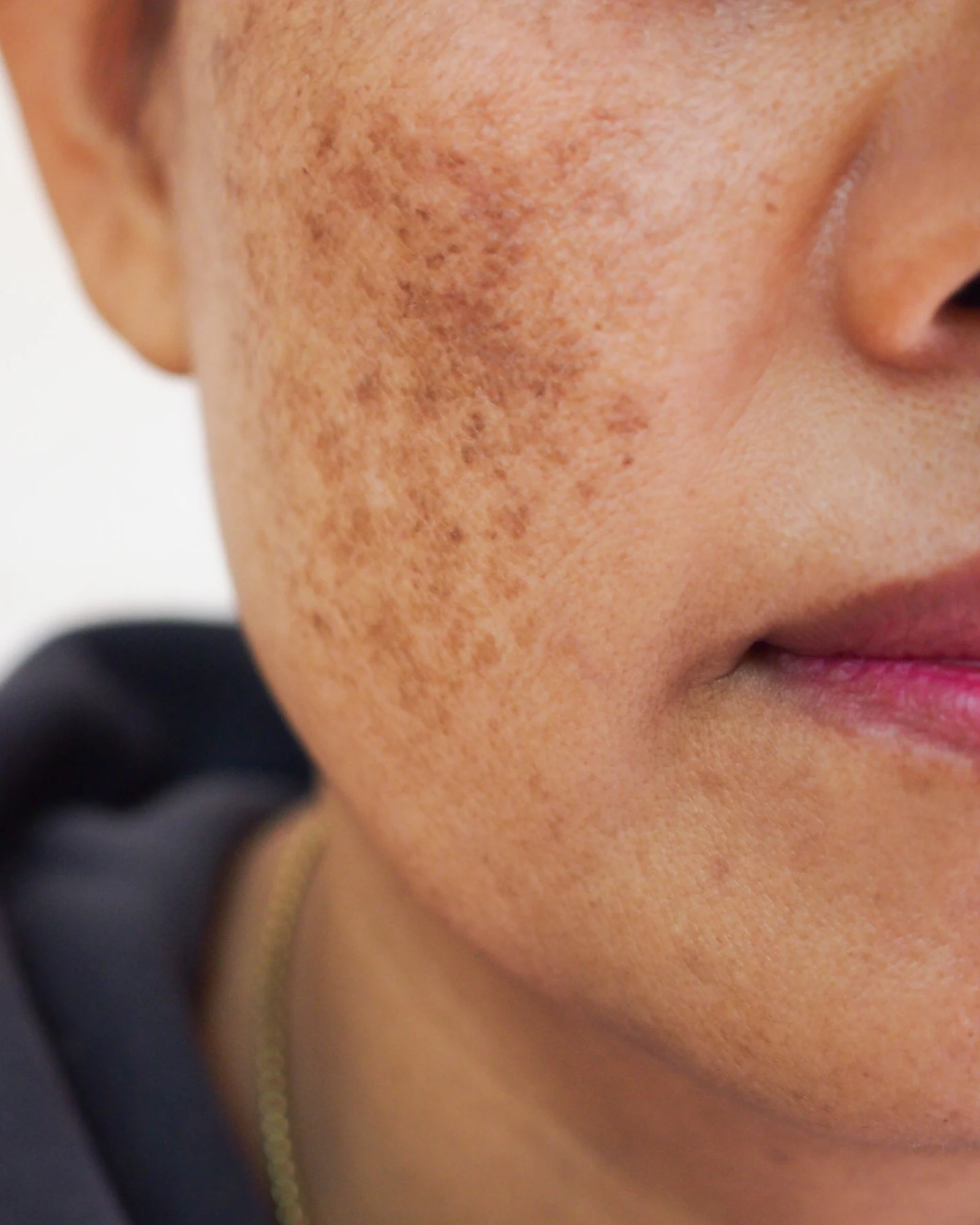
What really causes melasma? Melasma is set off by sunlight, hormones and your genes, but it is not only a pigment problem. Studies comparing melasma patches with the normal skin beside them find more inflammatory cells, more blood vessels and more sun damage inside the patches. Researchers think this low-level inflammation keeps pigment cells switched on, which may explain why melasma is slow to fade and so often comes back.
That is only half of it. Over the past 15 years, researchers have looked closely at melasma skin and found something most advice leaves out: the skin inside a melasma patch is quietly inflamed. That changes how you look after it.
Melasma is not just pigment
When researchers take a tiny sample of a melasma patch and compare it with the normal-looking skin right beside it, the patch is different in four ways.
- More inflammatory cells. In a study of 20 women, melasma patches held more immune cells than nearby skin, and two inflammatory messengers (IL-17 and COX-2) were significantly higher1
- More blood vessels. One study found the area covered by blood vessels was about 69% greater in melasma skin2,3
- More sun damage. Marked sun damage in the deeper layer was seen in 83% of melasma patches, compared with 29% of the skin beside them3,4
- A weakened layer between the top and deeper skin. In one study this layer was damaged in up to 95% of samples, which may let pigment drop deeper, where it is harder to shift3,4
The authors of the first study concluded that melasma “is characterized by chronic inflammatory cells and mediators, which may explain its recurrent nature”.1 Other researchers now describe melasma as a sun-ageing disorder of the skin in people who are genetically prone to it, not simply a pigment disorder.5
Why melasma fades and then comes back
Pigment cells do not act alone. They respond to signals from the skin around them, and inflamed, sun-damaged skin sends more of those signals.1,3 So if the pigment fades but the skin underneath is still inflamed, the conditions that made the pigment are still there. Reviews of the research note that melasma often returns even after it has improved.3
Irritation adds to the problem. In a study of 197 women with melasma, one in four reported that inflammation or irritation of the skin had triggered or worsened their patches.6 And in skin that tans easily, anything that inflames the skin can leave extra pigment behind.3
This is why stinging, burning or peeling is not a sign that something is working. For melasma, irritated skin is skin that is being pushed to make more pigment.
 RelatedWhy melasma comes back every summer
Melasma in Asian skin
Melasma is especially common in Asian women in their thirties and forties,3 and much of what we know about inflammation in melasma comes from studies of Asian skin, including the Korean research described above.3,6
If you have Asian skin, you may already know the other half of the story: your skin marks easily. A pimple, a scratch or a product that was too strong can leave a dark patch that lasts for months. The research agrees. In Asian skin, anything that inflames the skin carries a higher risk of leaving extra pigment behind.3
That is why a careful approach matters so much. It is reasonable to ask anyone looking after your melasma how they will keep your skin from being irritated along the way. Our doctors ask about your skin type and how your skin has reacted to products and procedures before, and they start gently for that reason.
The main causes of melasma
Sunlight, including the light you can see
Ultraviolet light and visible light both prompt your skin to make more pigment,7 and UV is thought to drive the inflammation described above.1 In one study, visible light alone caused pigmentation that lasted up to three months.8 See Why does melasma come back every summer?
Hormones
Pregnancy is a well-known trigger, and hormonal contraception and hormone replacement therapy are implicated in about one in four affected women.7 If you think a prescribed medicine may be involved, talk to your doctor before changing anything. We cover pregnancy in Melasma in pregnancy.
Your genes
Melasma runs in families. Between 55% and 64% of people with melasma have a relative with it.8
Who gets it
Mostly women, at a generally accepted ratio of about nine to one, usually starting between the ages of 20 and 40, and most often in skin that tans easily.7,8
Faded, then came back? A Qr8 doctor can look at your melasma, what may be keeping your skin inflamed, and anything else that is bothering you, by private video. Book a doctor consultation →
What this means for looking after melasma skin
If inflammation is part of the problem, then keeping your skin calm matters as much as anything you put on the pigment.
- Protect it from light every day. A broad-spectrum SPF 50+ sunscreen, a hat and shade, all year. See the best sunscreen if you have melasma
- Use fewer products. A short, simple routine gives your skin less to react to
- Mind how you apply things. Use the amount you were told to, spread it gently, and do not rub or scrub. How a product goes on affects how your skin responds
- Stop anything that stings or burns and tell your doctor or nurse
- Change one thing at a time, so you know what your skin is reacting to
These steps support your skin. They do not replace a diagnosis or a plan from a doctor.
How our doctors and nurses approach melasma
At Qr8 MediSkin we approach melasma as a condition of both pigment and inflammation. That shapes what happens when you see us.
- Your doctor looks at what may be keeping your skin inflamed, as well as the pigment itself, and plans for both
- Your doctor takes your skin type into account, including how easily your skin marks, and starts carefully
- Your nurse goes through your whole routine with you: what to keep, what to drop, how much to use and how to apply it
- We keep your routine simple, so there is less to irritate your skin
- Your nurse checks in as your skin changes, and your plan carries on after patches fade, because melasma is a long-term condition
Every plan is different, and we will not promise you a result. What we can promise is that someone who knows your skin stays with you.
What melasma gets mistaken for
Marks left after acne or a rash, sun spots, freckles and pigmentation caused by some medicines can all look like melasma.7 Many people have more than one of these, and some have redness or breakouts as well. Our guide to melasma vs hyperpigmentation explains the differences.
When to see a doctor
It is worth booking a consultation if:
- Your melasma faded and has come back
- The patches are spreading or getting darker
- Your skin stings, burns or reacts to what you are using on it
- Your skin marks easily and you want it looked after carefully
- You are not sure whether it is melasma, sun spots or something else
- There are other things about your skin you would like looked at, such as redness or breakouts
Tell your doctor everything that is bothering you. One consultation covers your whole face.
Doctor consultations
How Qr8 MediSkin can help
At Qr8 MediSkin you see an Australian registered doctor by private video, from home, with no referral. Your doctor looks at your whole face and sets a plan for everything that is bothering you. Your own nurse then supports you between appointments, through summer and beyond. You get your plan and all costs by email before you decide anything.
Want to read more first? See our guide to online melasma treatment.
No referral needed. Australia-wide.
Book a doctor consultationQuestions about what causes melasma
Why does melasma come back after it fades?
Melasma is a long-term condition. Studies show that melasma patches contain more inflammatory cells, blood vessels and sun damage than the skin beside them, and researchers think this ongoing inflammation may explain why it returns. Sunlight, heat and irritation can all set it off again.
Is melasma an inflammatory condition?
Research suggests inflammation plays a part. In one study, melasma patches had more immune cells and higher levels of two inflammatory messengers than nearby normal skin. Melasma is now often described as a sun-ageing disorder of the skin, not only a pigment disorder.
What causes melasma?
The main causes are sunlight (both UV and visible light), hormones such as those in pregnancy, and your genes. More than half of people with melasma have a family member with it.
Can irritating my skin make melasma worse?
It can. In a study of 197 women with melasma, one in four said inflammation or irritation had triggered or worsened their patches. Stinging, burning or peeling is a reason to stop and ask your doctor or nurse.
Is melasma different in Asian skin?
Melasma is especially common in Asian women, and Asian skin is more likely to be left with extra pigment after irritation or inflammation. That makes a gentle, low-irritation approach particularly important. Tell your doctor how your skin has reacted to products or procedures in the past.
Can I see a doctor about melasma online?
Yes. Qr8 MediSkin offers private video consultations with Australian registered doctors, 7 days a week, with no referral needed.
Melasma at Qr8
Private, long-term care with our doctors and nurses for your whole face, Australia-wide.
Melasma careReferences
- Rodríguez-Arámbula A, Torres-Álvarez B, Cortés-García JD, et al. CD4, IL-17, and COX-2 are associated with subclinical inflammation in malar melasma. Am J Dermatopathol. 2015;37(10):761-766. https://doi.org/10.1097/dad.0000000000000378
- Kim EH, Kim YC, Lee ES, Kang HY. The vascular characteristics of melasma. J Dermatol Sci. 2007;46(2):111-116. https://doi.org/10.1016/j.jdermsci.2007.01.009
- Kwon SH, Hwang YJ, Lee SK, Park KC. Heterogeneous pathology of melasma and its clinical implications. Int J Mol Sci. 2016;17(6):824. https://doi.org/10.3390/ijms17060824
- Torres-Álvarez B, Mesa-Garza IG, Castanedo-Cázares JP, et al. Histochemical and immunohistochemical study in melasma: evidence of damage in the basal membrane. Am J Dermatopathol. 2011;33(3):291-295. https://doi.org/10.1097/dad.0b013e3181ef2d45
- Passeron T, Picardo M. Melasma, a photoaging disorder. Pigment Cell Melanoma Res. 2018;31(4):461-465. https://doi.org/10.1111/pcmr.12684
- Noh TK, Choi SJ, Chung BY, et al. Inflammatory features of melasma lesions in Asian skin. J Dermatol. 2014;41(9):788-794. https://doi.org/10.1111/1346-8138.12573
- Oakley A, Doolan BJ, Gupta M. Melasma. DermNet. Updated October 2020. Read the article
- Ogbechie-Godec OA, Elbuluk N. Melasma: an up-to-date comprehensive review. Dermatol Ther (Heidelb). 2017;7(3):305-318. https://doi.org/10.1007/s13555-017-0194-1
This article is general information only. It isn’t a substitute for personal medical advice, so speak with a health professional about your own skin.