Perioral dermatitis or rosacea? Why a rash around your mouth and facial redness often show up together
It starts as a few small red bumps beside your mouth. You treat it like acne and it gets angrier. It clears, then it comes back. And when you look closely, the rash is not the only thing bothering you. Your cheeks flush. Your skin stings. Nothing in the bathroom cabinet seems to suit it any more.
Quick answer
Is it perioral dermatitis or rosacea? They are different conditions that can look alike and can appear together. Perioral dermatitis is an inflammatory rash around the mouth that can spread to the nose or eyes. On lighter skin it looks red, scaly or bumpy. On darker skin it can look brown or darker than the skin around it. Rosacea mostly shows as redness and flushing across the cheeks, nose and forehead. Many authors regard perioral dermatitis as a variant of rosacea, which is one reason a doctor will look at your whole face and not only the rash.
A rash around the mouth is often perioral dermatitis. Redness and flushing across the cheeks and nose is often rosacea. They are different conditions, but they can look alike, they share some triggers, and they can turn up on the same face.
What perioral dermatitis looks like
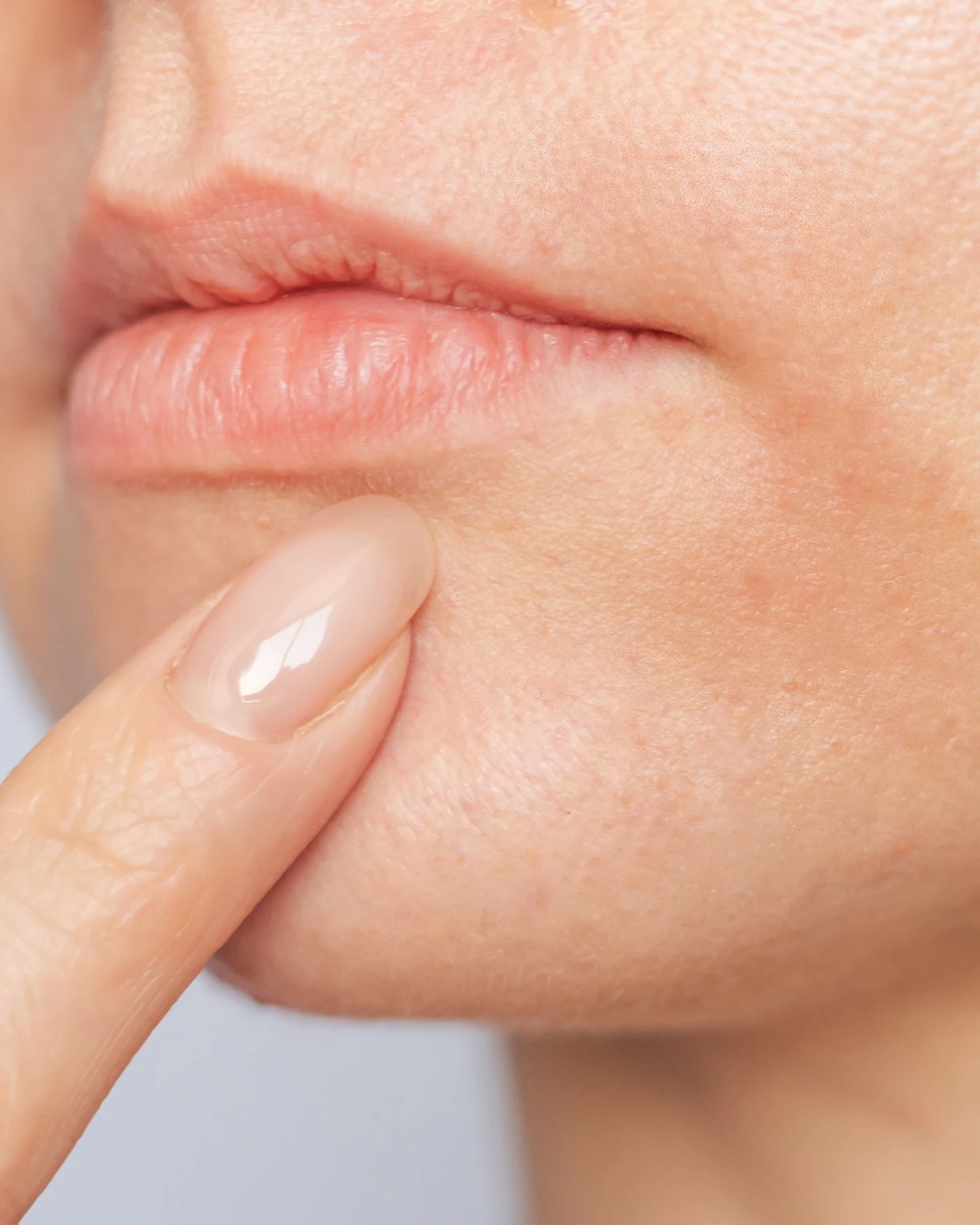
Perioral dermatitis is an inflammatory rash on the skin around your mouth. When it spreads to the nose or eyes, doctors call it periorificial dermatitis.1,2
- On lighter skin, a red, scaly or bumpy rash. On skin of colour, the rash can look brown or darker than the skin around it
- Skin that looks and feels dry
- Small spots that look like acne and may contain fluid
- Mild itching or burning
- Often a thin strip of clear skin right next to the lips7
It is not an infection, and you cannot pass it to anyone else.
Who gets it
Perioral dermatitis has mostly been described in fair-skinned women in their 20s and 30s, but it is increasingly seen in all skin types and ethnicities, and in men.1 About 1% of people have at least one episode in a year. Many also have a history of hay fever, eczema or asthma.3
Why it is so frustrating
Perioral dermatitis is often long-lasting and commonly comes back.1 Left alone, an episode can last weeks or months. It is also regularly mistaken for acne, and acne products tend to irritate it further.
How rosacea is different
Rosacea is a long-term inflammatory skin condition that mainly affects the centre of the face. Its features include:9
- Redness across the cheeks, nose, chin or forehead that does not fully fade
- Flushing that comes on with heat, sun, exercise, alcohol or stress
- Small visible blood vessels
- Bumps and spots that can be mistaken for acne
- Eyes that feel dry, gritty or irritated
The pattern is the main clue. Perioral dermatitis clusters around the mouth, nose and eyes. Rosacea spreads across the central face, and flushing is a big part of it.
 RelatedRosacea in summer: why it flares and how to stay ahead of it
Why they are so often mentioned together
The two conditions overlap in three ways.
They can look alike
Both can cause red bumps on the face, and both are regularly mistaken for acne. Many authors regard perioral dermatitis as a variant of rosacea.8
They share triggers
Sunlight, sunburn, cold wind and indoor heating can all set off perioral dermatitis. Alcohol, hot drinks and spicy food are on the list too. People with rosacea report many of the same triggers: in a survey of 431 people with rosacea, 80% named sun and 80% named hot weather.10
They can appear on the same face
Having one does not rule out the other. Acne, seborrhoeic dermatitis and contact dermatitis can also look similar or sit alongside them.7 That is why the diagnosis matters, and why it helps to have your whole face looked at.
What causes perioral dermatitis
The cause is still unclear.2 It is likely to be a mix of your genes, your environment and how your own immune system reacts.3 Researchers are also studying whether changes in the bacteria that live on the skin play a part.4
What the triggers have in common is that they disturb the skin barrier, and the skin becomes dry. Trying to fix that dryness by exfoliating, or by rubbing the flakes off, makes it worse. This is also why perioral dermatitis is more common in winter, when skin is already dry.
There is no good evidence that gut health causes perioral dermatitis, so probiotics are not an evidence-based treatment for it.
Known triggers
Most people have more than one trigger, which is why finding a single root cause is close to impossible. These are the ones reported:1,2
- Steroids. Long-term steroid creams, inhalers or tablets. A steroid cream on the rash often settles it at first, and then it comes back worse when the cream is stopped2
- Toothpaste and mouth products. Fluoride, strongly flavoured (especially mint or cinnamon) and foaming toothpastes, chewing gum, mints and dental fillings
- Skincare and cosmetics. Drying or fragranced products, including some sunscreens, and essential oils3
- Hair, nail and lash products. Shampoo and styling products (especially if your hair touches your face), gel nails and polish, lash extension glue and lash-lift solutions
- Environment. Sunlight, sunburn, cold wind, central heating and open fires
- Hormones. Periods, pregnancy and the contraceptive pill
- Illness and stress. Especially flu and COVID
- Masks, smoking and vaping. Flavoured vapes in particular
- Food and drink. Spicy food, alcohol and hot drinks
- Allergies and other factors. Metal allergy from jewellery, piercings or glasses frames, cat allergy, low iron or zinc, and some cholesterol medicines
Tell your doctor about everything you use, including anything prescribed for you. Never stop a prescribed medicine, such as an asthma inhaler or a cholesterol tablet, without talking to your doctor first.
More than one thing going on? A Qr8 doctor looks at your whole face and everything that is bothering you, in one private video consultation. Book a doctor consultation →
Why summer makes both harder
An Australian summer brings several triggers together: stronger UV, sunburn, and more sunscreen and make-up on your skin. If your rash and your redness both get worse as the weather warms up, that pattern is useful information for your doctor.
We have written more about this in Rosacea in summer: why it flares and how to stay ahead of it.
Looking after your skin in the meantime
The usual first step is to strip everything back. Doctors sometimes call this zero therapy: nothing on the affected skin except a plain, fragrance-free moisturiser, so the skin barrier can repair itself. Many cases settle this way.
- Cleansing. Skip cleanser on the area and use a little warm water
- Moisturiser. Use a plain, fragrance-free, nourishing moisturiser. As the rash heals it often turns dry and flaky, and a plain petroleum jelly can help
- Leave the flakes alone. Do not rub them off, scrub or use acid exfoliants. Friction and irritation can bring the rash back
- Make-up. Keep it off the area until the skin has healed
- Toothpaste. Switch to a flavour-free, non-foaming one, and brush your teeth before you rinse your face, not after
- Avoid. Strong mints and gum, essential oils (especially tea tree and eucalyptus), and skincare fragranced with them
- Sun. Limit your time in the sun and use a hat and shade. Sunscreen can be a trigger for some people, so ask your doctor what to use on the area while it heals
Do not put a steroid cream on the rash unless a doctor who knows you have perioral dermatitis has told you to.
Perioral dermatitis can spread quickly. If it is not settling, a doctor can confirm the diagnosis and talk to you about prescription options. When the triggers are removed and it is treated promptly, it usually heals without leaving scars.
When to see a doctor
It is worth booking a consultation if:
- The rash keeps coming back, has lasted more than a few weeks, or is not settling after you have stripped your routine back
- It is spreading quickly
- It has reached your nose or eyes
- You also have redness or flushing that does not settle
- You are not sure whether it is perioral dermatitis, rosacea, acne or something else
- There are other things about your skin you would like looked at, such as pigmentation or breakouts
Many people who come to us about a rash around the mouth mention something else as well. Tell your doctor all of it. One consultation covers your whole face.
Doctor consultations
How Qr8 MediSkin can help
At Qr8 MediSkin you see an Australian registered doctor by private video, from home, with no referral. Your doctor looks at your whole face, works out what is going on, and sets a plan for everything that is bothering you. Your own nurse then supports you between appointments. You get your plan and all costs by email before you decide anything.
Want to read more first? See our guides to perioral dermatitis treatment and online rosacea treatment.
No referral needed. Australia-wide.
Book a doctor consultationQuestions about perioral dermatitis and rosacea
Can you have perioral dermatitis and rosacea at the same time?
Yes. They are different conditions, but they can appear together, and many authors regard perioral dermatitis as a variant of rosacea. A doctor can look at the pattern across your whole face.
How do I tell perioral dermatitis from rosacea?
Location is the main clue. Perioral dermatitis sits around the mouth and can spread to the nose or eyes. Rosacea mainly causes redness and flushing across the cheeks, nose and forehead. Because they can look alike, a doctor should confirm which you have.
Is perioral dermatitis contagious?
No. It is an inflammatory rash, not an infection, and it cannot be passed from one person to another.
Does perioral dermatitis go away by itself?
Many cases settle once triggers are removed and the skin is left alone apart from a plain, fragrance-free moisturiser. Without that, an episode can last weeks or months, and perioral dermatitis commonly comes back.
Should I use a steroid cream on perioral dermatitis?
Steroid creams are a recognised trigger. They often calm the rash at first, and then it returns worse when the cream is stopped. Talk to a doctor before using one, and before stopping any steroid you have been prescribed.
Do probiotics help perioral dermatitis?
There is no good evidence that gut health causes perioral dermatitis, so probiotics are not an evidence-based treatment for it.
Can I see a doctor about perioral dermatitis online?
Yes. Qr8 MediSkin offers private video consultations with Australian registered doctors, 7 days a week, with no referral needed.
Perioral dermatitis at Qr8
Private care with our doctors and nurses for your whole face, Australia-wide.
Perioral dermatitis careReferences
- Searle T, Ali FR, Al-Niaimi F. Perioral dermatitis: diagnosis, proposed etiologies, and management. J Cosmet Dermatol. 2021;20(12):3839-3848. https://doi.org/10.1111/jocd.14060
- Tempark T, Shwayder TA. Perioral dermatitis: a review of the condition with special attention to treatment options. Am J Clin Dermatol. 2014;15(2):101-113. https://doi.org/10.1007/s40257-014-0067-7
- Dirschka T, Weber K, Tronnier H. Topical cosmetics and perioral dermatitis. J Dtsch Dermatol Ges. 2004;2(3):194-199. https://doi.org/10.1046/j.1439-0353.2004.04764.x
- Ferček I, Lugović-Mihić L, Tambić-Andrašević A, et al. Features of the skin microbiota in common inflammatory skin diseases. Life. 2021;11(9):962. https://doi.org/10.3390/life11090962
- Veraldi S, et al. 2023. PubMed 37288278
- Bukvić Mokos Z, et al. 2015. PubMed 26415314
- Shah N. Periorificial dermatitis. DermNet. July 2022. Read the article
- Tolaymat L, Syed HA, Hall MR. Perioral dermatitis. StatPearls. Updated 6 July 2025. Read the review
- Gallo RL, Granstein RD, Kang S, et al. Standard classification and pathophysiology of rosacea: the 2017 update by the National Rosacea Society Expert Committee. J Am Acad Dermatol. 2018;78(1):148-155. https://doi.org/10.1016/j.jaad.2017.08.037
- National Rosacea Society. New survey finds rosacea worsens with exposure to heat sources. 25 May 2010. Read the survey
This article is general information only. It isn’t a substitute for personal medical advice, so speak with a health professional about your own skin.