Keratosis pilaris: what it is and what helps
Those small, rough bumps on the backs of your arms have a name. Keratosis pilaris, often called chicken skin, is common, harmless and stubborn. Here is what it is, what the research says helps, and when it is worth seeing a doctor.
Quick answer
How do you get rid of keratosis pilaris? There is no cure for keratosis pilaris, but it can be managed. The bumps are plugs of keratin in the hair follicles, and they are more noticeable when skin is dry. Gentle washing, moisturising twice a day and a moisturiser containing urea, lactic acid or salicylic acid are the first steps. Scrubbing tends to make it worse. For many people it eases with age.
What keratosis pilaris is
Keratosis pilaris (KP) is one of the most common skin conditions there is. It is estimated to affect 50 to 80% of adolescents and up to 40% of adults.1 It is harmless and it is not contagious.
Each bump is a small plug of keratin, the protein that makes up the outer layer of your skin, sitting in the opening of a hair follicle. When researchers looked closely at the bumps in 25 people with KP, every one had a tightly coiled hair trapped inside the follicle.1
KP often runs in families. In one study, 39% of people with KP had a relative with it, and more than a third also had eczema, asthma or hay fever.2 It is more common in people with dry skin.
What it looks like, and where
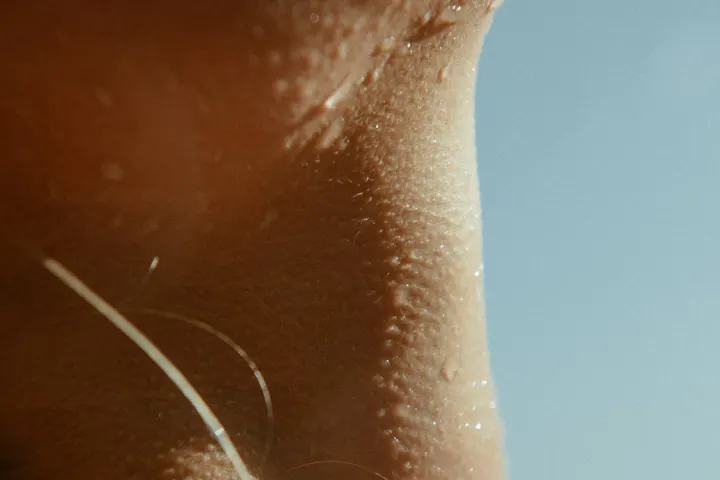
The bumps are tiny, white or skin-coloured, and feel rough, like sandpaper or permanent goosebumps. They can be itchy. They are sometimes mistaken for pimples.
They usually appear on the backs of the upper arms and the fronts of the thighs. In a study of 49 people with KP, 92% had it on their arms, 59% on their legs, 41% on their face and 30% on their buttocks.2
The skin around each bump can look pink or red in lighter skin. In deeper skin tones the bumps and the skin around them can look brown or darker than the rest of the skin.
Does keratosis pilaris go away?
Sometimes. In the same study, KP had improved with age in 35% of people, stayed the same in 43% and become worse in 22%. Where it improved, the average age was 16.2
It also changes with the seasons. Eight in ten people noticed a seasonal pattern, and of those, about half said it was better in summer and about half said it was worse in winter.2 Dry winter air and heavier clothing are the likely reasons. Many people only start looking for answers in summer, when arms and legs are on show.
If your KP does not bother you, you do not need to do anything about it.
What you can do at home
Keeping the skin from drying out comes first. Scrubbing does not.
- Wash gently. Use a fragrance-free cleanser and keep showers and baths short and warm, not hot.
- Moisturise twice a day. Apply a rich, fragrance-free moisturiser straight after bathing, while your skin is still damp.
- Add moisture to the air. A humidifier in the bedroom or office can help in winter.
- Go easy on exfoliating. Do it gently if at all, and always moisturise afterwards.
- Give it time. Stay with the same routine for at least six weeks before you judge it.
Does Vaseline help keratosis pilaris?
Plain petroleum jelly, such as Vaseline, does not dissolve the keratin plugs. What it does well is hold water in the skin, and stopping the skin from drying out is the first job in looking after KP.
Use a very small amount and rub it in well, so it does not mark your clothes or sheets. Put more on if your skin feels itchy. You can read more in Is petrolatum (Vaseline) a good moisturiser?
Moisturisers that help smooth the bumps
Some moisturisers contain ingredients that gently loosen the keratin plugs. The main ones are urea (above 10%), lactic acid and salicylic acid.3,5
In one trial, 50 people with KP used either a 10% lactic acid cream or a 5% salicylic acid cream twice a day for 12 weeks. The bumps reduced in both groups, and the only side effect was mild irritation where the cream was applied.4
The research on KP is still limited. A 2025 review of these ingredients found that all three may help, but that the studies were small and short.5 That is worth knowing before you spend a lot on a product that promises to fix it.
What tends to make it worse
- Scrubbing with rough cloths, brushes or gritty scrubs
- Long, hot showers and baths
- Fragranced soaps, body washes and lotions
- Picking or squeezing the bumps
When it may not be keratosis pilaris
Not every rough or uneven patch of skin is KP. Two other things are often mixed up with it.
Marks and uneven colour. Brown or red marks that stay after bumps or spots have settled are a different concern from the bumps themselves. See our page on uneven skin tone.
Sun damage. Years of sun can leave the skin on your arms, chest and face rough, blotchy or uneven. See our page on sun damaged skin.
Qr8 MediSkin does not treat keratosis pilaris. Our doctors do see patients about uneven skin tone and sun damaged skin.
When to see a doctor
See your GP if six weeks of consistent skincare has made no difference, if there is a lot of redness, or if you are not sure the bumps are KP.
A doctor can prescribe creams to use alongside your moisturising routine.6 Some can make the skin redder for a short time while it adjusts, and they can be costly over large areas.
For stubborn KP there is early evidence for some light and laser treatments. A review found 17 studies covering 175 people in total, so the evidence is still small.7 Lasers need extra care in deeper skin tones, where they can trigger pigmentation.
Questions about keratosis pilaris
Is keratosis pilaris contagious?
No. Keratosis pilaris is not an infection and cannot be passed from one person to another. It often runs in families.
Can keratosis pilaris be cured?
There is no cure, but it can be managed with gentle washing and regular moisturising. In one study it had improved with age in about a third of people.
Does Vaseline help keratosis pilaris?
Petroleum jelly does not dissolve the keratin plugs, but it is very good at stopping the skin from drying out, which is the first step in looking after keratosis pilaris. Use a very small amount and rub it in well.
Does scrubbing or exfoliating help?
Hard scrubbing tends to irritate the skin and can make keratosis pilaris look worse. Exfoliate gently, if at all, and always moisturise afterwards.
Is keratosis pilaris worse in winter or summer?
For many people it is worse in winter, when the air is dry, and better in summer. People often notice it more in summer because their arms and legs are uncovered.
Does Qr8 MediSkin treat keratosis pilaris?
No. Qr8 MediSkin does not treat keratosis pilaris. If good skincare has not helped after six weeks, see your GP.
Uneven skin tone at Qr8
Marks and patches that will not shift? See how our doctors and nurses look after uneven skin tone.
Uneven skin toneReferences
- Thomas M, Khopkar US. Keratosis pilaris revisited: is it more than just a follicular keratosis? Int J Trichology. 2012;4(4):255-258. https://doi.org/10.4103/0974-7753.111215
- Poskitt L, Wilkinson JD. Natural history of keratosis pilaris. Br J Dermatol. 1994;130(6):711-713. https://doi.org/10.1111/j.1365-2133.1994.tb03406.x
- Wang JF, Orlow SJ. Keratosis pilaris and its subtypes: associations, new molecular and pharmacologic etiologies, and therapeutic options. Am J Clin Dermatol. 2018;19(5):733-757. https://doi.org/10.1007/s40257-018-0368-3
- Kootiratrakarn T, Kampirapap K, Chunhasewee C. Epidermal permeability barrier in the treatment of keratosis pilaris. Dermatol Res Pract. 2015;2015:205012. https://doi.org/10.1155/2015/205012
- Dampa E. The effectiveness of topical keratolytics (alpha hydroxy acids/beta hydroxy acids/urea) in treating keratosis pilaris: a review of the literature. Cureus. 2025. https://doi.org/10.7759/cureus.100507
- Maghfour J, Ly S, Haidari W, et al. Treatment of keratosis pilaris and its variants: a systematic review. J Dermatolog Treat. 2022;33(3):1231-1242. https://doi.org/10.1080/09546634.2020.1818678
- Kechichian E, Jabbour S, El Hachem L, et al. Light and laser treatments for keratosis pilaris: a systematic review. Dermatol Surg. 2020;46(11):1397-1402. https://doi.org/10.1097/dss.0000000000002441
This article is general information only. It isn’t a substitute for personal medical advice, so speak with a health professional about your own skin. Qr8 MediSkin does not treat keratosis pilaris.